We earn a commission if you buy through our links, at no extra cost to you.
Best 3D Printer for Cosplay Armor, Props and Figures
Picking a 3D printer for cosplay: helmet-size build volume, PLA vs PETG, sanding and priming, resin for details, and convention prop rules, with four models.
At a glance
For cosplay armor and helmets in one piece, the Creality K2 Plus Combo has the biggest build volume, and the Bambu Lab H2D AMS Combo suits daily printing. The Bambu Lab P2S Combo is the enclosed all-rounder, and the Elegoo Saturn 4 Ultra 16K is the resin pick for faces and figures.


Cosplay is where a 3D printer stops being a gadget and becomes a costume workshop. A helmet, a pair of gauntlets, a prop blaster or an action figure for the shelf can all come off one machine. The catch is that these projects ask more than a phone stand does: bigger parts, wearable weight, a good surface for paint and, at conventions, rules about what you can carry. This guide walks through what matters and matches four models from the site to the kind of builder you are.
We do not test products. Every number is the maker’s own, from the maker’s page, and we say where a page is silent.
Build Volume: The First Decision
A full-size helmet needs roughly 10 to 12 inches of height. Many printers with a 10-inch bed cannot fit one in a single piece. You have two choices: split the model into halves and join them, or buy more volume.
Splitting works, and plenty of makers do it. But every seam must be glued, sanded, filled and primed, which adds hours of finishing and a weaker joint. Printing in one piece saves that work and gives a stronger shell.
For reference, the Bambu Lab P2S and A1 families list about 10 in (256 mm) per side. Bambu pitches the A1 volume as big enough to print a helmet in one piece, which in practice means slightly under full size. The Bambu Lab H2D lists 13.8 x 12.6 x 12.8 in (350 x 320 x 325 mm), but that figure is the combined reach of two nozzles: Bambu’s single-nozzle area is narrower in one direction. The Creality K2 Plus lists 13.8 in (350 mm) in every direction, the largest on the site.
A bigger printer is also a bigger, heavier machine. The K2 Plus weighs about 77 lb (35 kg) according to Creality, so plan a sturdy table and a room that is not a closet.
PLA, PETG and Heat
For armor you wear, the filament decides how it survives a day.
PLA prints easily, sands well and holds detail. It softens at lower temperatures than the other common filaments, so a piece left in a hot car trunk or in direct sun can warp. If your convention involves a long outdoor line in summer, carry the armor in an insulated bag.
PETG handles heat better and is slightly more flexible, which is useful for pieces that flex when you move. It strings more than PLA and can be harder to sand cleanly.
ABS and ASA are the materials people pick for parts that must survive heat or sunlight. They warp on open printers, so they ask for an enclosed, ideally heated, chamber. They also release more odor and fine particles. UL Research Institutes’ Chemical Insights team lists ASA, ABS, HIPS and nylon among the high-emitting filaments for material extrusion printers and says exposure may exceed recommended limits, so if you print them, ventilate the room, keep the door closed and do not sit next to the printer.
Weight, Walls and Infill
Armor you wear for eight hours must be light. Thin walls and low infill keep weight down, and a few well-placed reinforcements keep it from cracking. Avoid solid prints. Print a short section first, then pull the printed piece onto your body or a trial form before committing to a 20-hour print. Big prints take many hours or even days, so reliability matters more than raw speed.
Sanding, Filler Primer and Paint
Layer lines show through paint. The common finishing path is simple:
- Remove supports and sand rough spots.
- Join split sections with glue and fill the seams.
- Spray filler primer, which fills fine lines.
- Sand again, with finer grit, and repeat the primer if needed.
- Paint, then seal.
Budget more time for finishing than for printing. Fewer seams means less work, which is why volume matters.
Where Resin Fits: Faces, Fine Details and Figures
Filament printers show layer lines and cannot match very fine detail. Resin (MSLA) printers cure liquid resin with ultraviolet light and are the tool for sculpted faces, small ornaments, jewelry masters and action figures. The cost is workflow. MatterHackers’ resin safety guide strongly encourages nitrile gloves, calls good ventilation critical and suggests an N95 or NIOSH-approved respirator for strong-smelling resins. It says isopropyl alcohol is for tools and surfaces, never skin, that contaminated paper towels and gloves should be cured in sunlight or UV light before disposal, and that uncured resin never goes down the drain or into regular trash. Resin is for an adult with a ventilated space, away from children and pets.
Convention Rules for Props
Prop rules differ by event, and they change. Comic-Con International’s convention policies page says that all costume props must be inspected daily at one of the Costume Props Desks, that no functional or sharp-edged props or weapons are allowed, that replica projectile costume props must be rendered inoperable and covered with brightly colored caps, and that final approval is at the sole discretion of the Prop Safety Officers. A realistic-looking printed blade or blaster may be turned away even if it is plastic. Read your event’s current policy, and design with that in mind: rounded edges, safe tips and a clear look of a prop, not a weapon.
Four Models for Cosplayers
For all ten models, see our 3D printer comparison.
Creality K2 Plus Combo: Helmets and Armor in One Piece
A premium enclosed printer with a 13.8-inch (350 mm) cube, an actively heated chamber and a four-spool CFS. For helmets, large armor pieces and long props.
According to Creality, the K2 Plus has a 13.8 in (350 x 350 x 350 mm) build volume, a chamber heated up to 140 °F (60 °C), a nozzle up to 662 °F (350 °C) and a bed up to 248 °F (120 °C). Filaments listed include PLA, PETG, ABS, ASA and carbon-fiber blends. The combo includes one CFS (four spools), and four units can reach 16 colors. Creality gives no decibel rating, and at 77 lb (35 kg) it is a machine for a garage or workroom. Our Creality K2 Plus Combo profile covers the trade-offs.
Bambu Lab H2D AMS Combo: For Daily, Prosumer Printing

A premium dual-nozzle printer with a 149 °F (65 °C) heated chamber and a big build area. For cosplayers who print most days or sell prints.
Bambu lists a total volume of 13.8 x 12.6 x 12.8 in (350 x 320 x 325 mm), a hotend up to 662 °F (350 °C) and a 149 °F (65 °C) heated chamber. A second nozzle can handle support material or a second color, which cuts purge waste. The laser and cutting modules are sold separately. It is complex and priced as a premium machine, so it makes sense if you will use what it offers. See the Bambu Lab H2D AMS Combo profile.
Bambu Lab P2S Combo: The Enclosed All-Rounder
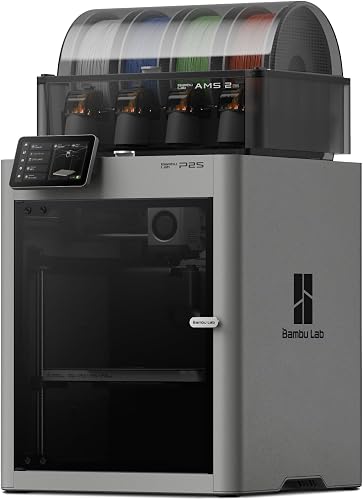
A premium enclosed CoreXY printer with a 10-inch cube and AMS 2 Pro filament drying. For gauntlets, bracers, props and helmets you can split or scale.
According to Bambu, the P2S has a roughly 10-inch (256 mm) build volume, a 572 °F (300 °C) nozzle, a 230 °F (110 °C) bed, a carbon-filter airflow system and a quick-swap hotend. It handles ABS and ASA indoors with care for ventilation. Our profile points to the K2 Plus for armor that exceeds 10 inches. See the Bambu Lab P2S Combo profile.
Elegoo Saturn 4 Ultra 16K: Faces, Small Details and Figures
A mid-range resin printer for sculpted faces, ornaments and action figures. For adults with a ventilated space and gloves.
Elegoo lists a 10-inch 16K monochrome LCD, 14 x 19 micron XY resolution and a roughly 8.3 x 4.7 x 8.7 in (211.68 x 118.37 x 220 mm) build volume. A tank heater keeps resin at 86 °F (30 °C). The footprint is wide and shallow, so taller figures are printed in sections. Plan for resin, washing and curing supplies. See the Elegoo Saturn 4 Ultra 16K profile.
Pairing Machines to Projects
| Project | Model |
|---|---|
| One-piece helmet with a crest | Creality K2 Plus Combo |
| Daily printing, engineering filaments | Bambu Lab H2D AMS Combo |
| Gauntlets, bracers, scaled helmets | Bambu Lab P2S Combo |
| Faces, ornaments, action figures | Elegoo Saturn 4 Ultra 16K |
Sources
- Creality K2 Plus Combo official product page
- Bambu Lab blog: Bambu Lab launches H2D
- Bambu Lab blog: meet the P2S
- Bambu Lab A1 official product page
- Elegoo Saturn 4 Ultra 16K official product page
- MatterHackers: Photopolymer Resin 3D Printing Safety
- UL Research Institutes: Comprehensive emissions data from material extrusion 3D printing
- Comic-Con International: Convention policies
Frequently asked questions
How big does a printer need to be for a cosplay helmet?
A full-size helmet needs roughly 10 to 12 inches in one piece, and many 10-inch printers cannot fit one without splitting it or scaling it down. The Creality K2 Plus Combo lists 13.8 in (350 mm) per side, which leaves room for crests and horns. Bambu says the 10-inch (256 mm) A1 can print a helmet slightly under full size.
Is PLA strong enough for wearable armor?
PLA is easy to print and sand, and it is fine for a convention day indoors. It softens at lower temperatures than PETG, ABS or ASA, so do not leave a PLA piece in a hot car or in direct sun. PETG handles heat better and is a common next step. Keep the design light with thin walls and low infill, then add strength where it is needed.
Can I take a 3D printed prop to a convention?
Usually, but every event has rules. Comic-Con International's policy says all costume props must be inspected daily at a Costume Props Desk, that no functional or sharp-edged props or weapons are allowed, that replica projectile props must be inoperable and capped with brightly colored tips, and that Prop Safety Officers have final approval. Read your event's current policy before you build.
Do I need resin for action figures and detailed props?
Not necessarily, but resin gives finer surface detail than filament, which suits faces, small ornaments and figures. It also needs nitrile gloves, ventilation, isopropyl alcohol cleanup and proper disposal, so it is a second machine for an adult with a ventilated space, not a first one.
Do I have to sand and prime printed armor?
Yes, if you want it to look smooth. Layer lines show through paint. The usual path is sanding, filling gaps and seams with filler primer, sanding again and then painting. Splitting a model into parts adds seams to hide, which is one reason a bigger printer saves finishing time.
Is the Elegoo Saturn 4 Ultra safe for a shared apartment?
Resin changes the picture. MatterHackers' resin safety guide calls good ventilation critical and recommends nitrile gloves. Keep resin away from children and pets, use a ventilated room and follow the resin's safety data sheet. If that is not possible, stay with a filament printer.