We earn a commission if you buy through our links, at no extra cost to you.
Best 3D Printer for Kids 10+ and Teens
Choosing a 3D printer for kids 10 and up and teens: supervision, hot parts, enclosed vs open frame, PLA only, ventilation, and four models that fit a family.
At a glance
For kids 10 and up with an adult setting up and nearby, the Bambu Lab A1 mini is the simplest open-frame start, and the Bambu Lab A1 Combo adds four colors and more room. The Elegoo Centauri Carbon 2 Combo adds an enclosure, and the Flashforge AD5X is the budget multicolor pick.


Searches like “3D printer for kids” bundle two very different buyers: a parent shopping for a ten-year-old who loves building things, and a teenager who has watched a few videos and wants to make cosplay parts or phone stands. This guide is for both, with one condition that does not change: an adult sets the printer up, chooses where it lives and stays close while it runs. A 3D printer is closer to a hot glue gun plus a small appliance than to a toy.
Below we cover what the makers and safety bodies say, how to pick between an open frame and an enclosure, what to print first, and four models that suit a family project. We do not test products. Every figure is the maker’s own, and we say where a source is silent.
How Old Is Old Enough?
The one age statement we found is in Bambu Lab’s A1 mini user manual, which says: “Children under the age of 10 should not use the printer without supervision, as it may cause bodily injury.” The same manual says not to touch the nozzle or heated bed while the printer is operating. We read it through a ManualsLib copy, so check Bambu’s own wiki for the current wording. We did not find a comparable age line for the other printers below, and we make no claim about them.
Our reading: the practical floor for this guide is about ten, and even then the adult stays involved. For a younger child, a 3D pen or a print you make together is the realistic option, and that is all we will say on the subject. Teens can take over more of the routine, such as loading filament and removing prints, once an adult has shown them how.
What Can Actually Hurt a Kid
Three things deserve attention before you plug anything in.
Hot parts. The nozzle on these printers runs at up to 572 °F (300 °C) or hotter by the makers’ specifications, and the heated bed climbs to 176 to 230 °F (80 to 110 °C) depending on the model. Both stay hot after a print ends. The rule is simple: nobody reaches into the printer while it runs, and prints come off the bed after it has cooled.
Moving parts. On an open-frame printer such as the A1 mini or A1, the bed slides back and forth and the toolhead travels fast. Fingers do not belong there.
Fumes and particles. UL Research Institutes’ Chemical Insights team consolidated more than 500 exposure studies on material extrusion printers, the type that melts filament. It says these printers are the most widely used 3D printing method in non-industrial places such as offices and schools, and that their emissions are a mix of ultrafine particles and volatile organic compounds, some of them known carcinogens, irritants and developmental and reproductive toxins. It names nylon, ASA, ABS and HIPS as high-emitting filaments and says exposure may exceed recommended limits. The UL page does not spell out specific precautions, so the following is our own common-sense advice: use PLA, keep the printer in a room with airflow, keep it away from where anyone sleeps, and do not sit next to it for hours.
Open Frame or Enclosed?
An enclosed printer has walls and a door around the print area. That keeps drafts out, holds heat in and puts a physical barrier between curious hands and the hot, moving parts. For a family with a younger sibling or a pet, that matters. The cost is a bigger, heavier machine and usually a higher price tier.
An open-frame printer is simpler, lighter and often cheaper, and it can sit on a desk. Its hot parts are exposed, so it suits a home where an adult is nearby and the printer sits on a stable table out of reach of toddlers. Bambu also says it does not recommend enclosing the A1 models, so a homemade box is not a safety fix there.
Neither type is childproof. Treat the choice as a way to reduce risk, not remove it.
Rules That Make It Work
- PLA only. It is the standard beginner filament and the friendliest indoors. No ABS, ASA or nylon.
- No resin. Resin printers need gloves, ventilation, alcohol cleanup and hazardous-waste disposal. Our Elegoo Saturn 4 Ultra profile says it is not for children, and we agree.
- Printer on a hard, flat, stable surface. Not on a bed, a rug or a shelf at the edge of a room.
- Never leave a long print running unattended when nobody is home.
- Scrapers and tools stay with the printer and go back in the same place.
- Smoke or smell means stop. Unplug it and look for the cause.
- Check recalls before you buy new or used. The CPSC page for recall 24-264 covers the Bambu Lab A1 heatbed cable, discussed below.
What to Print First
Kids stay interested when the first print arrives within an hour and is theirs. Good starter projects are a name keychain, a phone stand, a desk organizer, a cable holder, a simple fidget toy, a chess piece or a small figurine. Model libraries such as MakerWorld, Printables and Thingiverse list free models; check each model’s license before you print and share it. A browser-based design tool like Tinkercad lets older kids make their own shapes, which is where most of the learning happens. Filament is the running cost to plan for, so buy a few spools of PLA at a time and let the kid choose colors.
Which Printers Fit a Family
We picked four from the site’s lineup. All are filament printers. For all ten models, see our 3D printer comparison.
Bambu Lab A1 mini: The Simplest Start
A compact budget printer with full-auto calibration that fits on a desk. The easiest way into printing for a teen with an adult nearby.
According to Bambu, the A1 mini has a 7.1-inch (180 x 180 x 180 mm) build volume, calibrates itself for each print and takes about 20 minutes to set up for a first print. It lists PLA, PETG, TPU and PVA as supported, 49 dB operation and a camera. The frame is open, so the nozzle and moving bed are reachable, and this is the model whose manual carries the under-10 supervision line. The volume is small: phone stands, figures and organizers fit, a helmet does not. Multicolor needs the optional AMS lite. Our Bambu Lab A1 mini profile covers the details.
Bambu Lab A1 Combo: More Room and Four Colors
A mid-range open-frame printer with a 10-inch build volume and a four-color AMS lite included. Good for a family that wants bigger prints and color.
Bambu lists a roughly 10-inch (256 x 256 x 256 mm) build volume, a four-spool AMS lite and the same self-calibration. It supports PLA, PETG and TPU and does not recommend ABS, ASA or nylon. Multicolor prints use more filament and time because each color change purges some. The A1 is open frame, with exposed hot parts. In June 2024 the CPSC announced recall 24-264 for about 12,800 Bambu Lab A1 printers sold from December 2023 through January 2024 because the heatbed cable could short-circuit if bent or damaged, and it identifies affected units by an “A” as the sixth digit of the serial number. Bambu says current units use an upgraded cable. If you buy a used A1, check the serial number first. See our Bambu Lab A1 Combo profile.
Elegoo Centauri Carbon 2 Combo: An Enclosure for a Busy House
A budget enclosed CoreXY printer with four-color CANVAS. A fit when you want walls around the hot parts and a quieter machine.
Elegoo lists an enclosed chamber, a 10-inch (256 x 256 x 256 mm) build volume, a 662 °F (350 °C) hardened steel nozzle, a 230 °F (110 °C) bed, full-auto calibration and operation under 45 dB. The enclosure is the draw for a family. The nozzle and bed run hotter than on the A1 models, so the rule against reaching inside stays. Elegoo’s page does not mention a carbon filter, so ventilation still matters, and it does not describe a built-in filament dryer. Customer comments on its page about support are mixed, so run a few trial prints in the first days. See the Elegoo Centauri Carbon 2 Combo profile.
Flashforge AD5X: Multicolor on a Tighter Budget
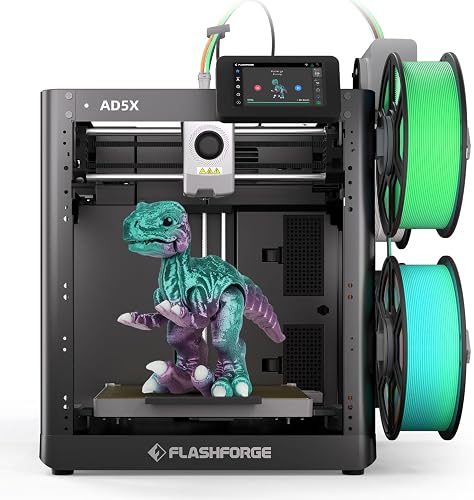
A budget CoreXY printer with a built-in four-color system. A pick for a multicolor family project when you accept an open frame and a smaller bed.
Flashforge lists an 8.7-inch (220 x 220 x 220 mm) build volume, an integrated four-spool IFS with no external box, a 4.3-inch touchscreen and one-click auto leveling, and says setup takes about ten minutes or less. The frame is open, with an enclosure kit sold separately according to our profile notes, so the same supervision rules apply as on the A1. Its software ecosystem is smaller than Bambu’s. Read the Flashforge AD5X profile before you decide.
Quick Picks
| Situation | Model |
|---|---|
| Smallest, simplest start for a teen | Bambu Lab A1 mini |
| Bigger prints and four colors | Bambu Lab A1 Combo |
| Walls around the hot parts | Elegoo Centauri Carbon 2 Combo |
| Multicolor on a budget | Flashforge AD5X |
A Short Setup Plan for Parents
- Read the manufacturer’s safety pages together and agree on the rules above.
- Pick the room: hard table, airflow, away from beds, within earshot.
- Print the first model with the kid watching the first layer.
- Keep PLA only and keep a log of what went wrong, because failed prints teach more than perfect ones.
- Add one new skill at a time: color change, a downloaded model, then a design of their own.
Sources
- Bambu Lab A1 mini user manual (ManualsLib copy)
- UL Research Institutes: Comprehensive emissions data from material extrusion 3D printing
- CPSC recall 24-264: Bambu Lab Recalls A1 3D Printers Due to Electric Shock and Fire Hazards
- Bambu Lab A1 mini official product page
- Bambu Lab A1 official product page
- Elegoo Centauri Carbon 2 Combo official product page
- Flashforge AD5X official product page
Frequently asked questions
What is the youngest age for a 3D printer?
Bambu Lab's A1 mini manual says children under the age of 10 should not use the printer without supervision. We would go further and treat any 3D printer as an adult-run machine for the first months, whatever the age. For younger children, a 3D pen or a model your family prints for them is the realistic option.
Is an enclosed printer safer for kids than an open one?
An enclosure puts a barrier between small hands and the hot nozzle, heated bed and moving parts, which is a real advantage. It is not a childproof lock, and the hot parts are still hot behind the door. Open-frame printers such as the Bambu Lab A1 mini expose them, so the printer needs a spot where an adult can watch it.
Which filament should kids use?
PLA. It is the most common beginner filament and the easiest on a household. Skip ABS, ASA and nylon: UL Research Institutes' Chemical Insights team lists them among the higher-emitting filaments for material extrusion printers. Bambu also does not recommend ABS or ASA on its open-frame A1 models.
Can a kid run the printer alone in their bedroom?
We would not. A printer can run for hours, the nozzle and bed stay hot, and fine particles and fumes are best kept out of sleeping areas. Put it in a room with airflow where an adult is nearby, and keep it off a bed or any soft surface.
Are resin printers okay for teens?
No. Resin printers use liquid resin that needs nitrile gloves, ventilation, alcohol cleanup and careful disposal, and our Elegoo Saturn 4 Ultra profile says plainly that it is not for children. Stick to filament printers for a family setup.
Was the Bambu Lab A1 recalled?
The U.S. Consumer Product Safety Commission announced recall 24-264 in June 2024 for the Bambu Lab A1 because of a heatbed cable that could short-circuit if bent or damaged. The notice identifies affected units by serial number, and that page does not mention the A1 mini. Check the notice if you buy used.